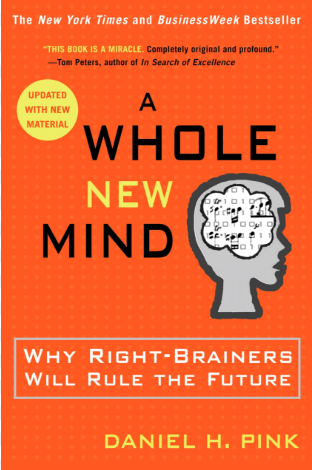
Book Review: A Whole New Mind by Dan Pink
What Yoga Therapy, Empathy, and AI Have in Common
I’m such a fan girl I can’t stop talking about Dan Pink, even in my yoga classes where I get to share Dan’s “science meets soul” research, anecdotes and thoughts for applying it to your life or yoga practice.
This won’t be my last Dan Pink book review. If yove the ideas, but don’t think you’ll sit down to read this one, check out this video with Dan https://www.youtube.com/watch?v=ZGWHPMEUWek. The only thing better than his writing is his speaking. #fangirl ❤
There are some books that shift your thinking—and others that make you feel seen. For me, A Whole New Mind by Dan Pink falls squarely into the second category. It didn’t radically change my worldview. Instead, it validated something I’ve known and felt deeply through years of working with people: that the so-called “soft skills” are not soft at all. They’re essential.
Pink argues that we’re moving out of the Information Age and into what he calls the Conceptual Age, where success and fulfillment will depend less on logical, linear, left-brain thinking—and more on creative, empathetic, right-brain strengths. He’s not anti-logic. He’s just showing us that logic is no longer enough.
This is something those of us in yoga therapy, coaching, and healing professions already know. Presence, intuition, storytelling, and connection are at the core of our work. What I appreciated most was how Pink backs this up with research, big-picture thinking, and real-world examples that help contextualize what we do within a wider cultural shift.
And now, as artificial intelligence becomes more embedded in our daily lives, this message feels even more timely. Machines can analyze data. They can write emails. But they can’t feel—at least not in the human, embodied way that we do. They don’t form healing relationships. They don’t sit with people in discomfort, grief, or transformation.
Pink’s message is this: Our edge as humans lies in our ability to create meaning.
Key Takeaways
🔹 High tech needs high touch. The more we lean into automation and AI, the more we need real, human-centered support systems. Yoga therapy, coaching, and wellness practices offer this in spades.
🔹 Design, Story, Empathy, Play, Meaning, and Symphony—Pink calls these the six essential aptitudes for the Conceptual Age. Yoga therapy touches nearly all of these every single day.
🔹 Right-brain skills aren’t just “nice to have”—they’re now “must-haves.” Especially in leadership, education, healthcare, and wellness.
🔹 Emotional intelligence and presence matter. They always have—but now, they’re the difference between being replaceable and being truly valuable in any field.
Action Steps & Reflections
- Lean into your gifts. If you’re someone who’s always been told you’re “too sensitive” or “too emotional,” recognize that these are now marketable, relevant, crucial skills.
- Balance your brain. While right-brain strengths are rising in value, we still need structure and logic. Think about how you can bring both sides into harmony. (This is yoga, after all.)
- Build AI awareness. Use AI where it supports your work—but not where it replaces your presence. Let it take care of repetitive tasks so you can focus more fully on the people you serve.
- Practice “symphony.” One of Pink’s six aptitudes, symphony is the ability to synthesize, see the big picture, and connect ideas across disciplines. If you’re combining yoga with science, Ayurveda with coaching, or wellness with behavior change, you’re already doing this.
- Make space for meaning. Whether you journal, meditate, or share stories in your sessions, focus on helping people make sense of their experience. That’s the gold.
This book is a powerful read for anyone who works with people, especially in wellness or education. It affirms what many of us already feel: that what we offer is not fluff—it’s exactly what the world needs more of.
Let’s keep leading with empathy, creativity, and intention. AI isn’t the enemy (I hope)—it just makes our humanness more important than ever.
Have you read A Whole New Mind? What resonated with you?
 ZenwithGwen